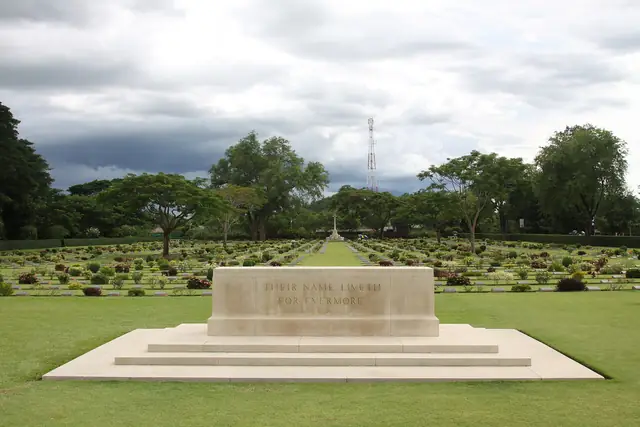
About 13,000 Allied prisoners of war died building the Thailand-Burma Railway between 1942 and 1943, and an estimated 80,000 to 100,000 Asian labourers died with them, based on Commonwealth War Graves Commission (CWGC) figures. After the war the graves scattered along the line were gathered into three cemeteries: Kanchanaburi and Chungkai in Thailand and Thanbyuzayat in Myanmar. The two in Thailand are a short drive apart, and the museums that explain the railway are a few minutes from the first.
This page answers the questions people actually search: what is open and what it costs, how to find a named grave, which museum to choose, how to get to Chungkai, what happens on Anzac Day and how to behave. It ends with a half-day route and a full-day route. Opening times and fees can change, so the practical fix is almost always to ask at the gate or the ticket desk.
We earn a commission if you book through our links. The price you pay does not change. How we choose
Quick facts before you go
| Kanchanaburi War Cemetery (Don Rak) | Free. On Saeng Chuto Road in town, opposite the Railway Centre. Open in the daytime and closes about 16:00 to 17:00, so check at the gate. Ask at the office if the gate is shut |
|---|---|
| Chungkai War Cemetery | Free, about 5 km west of town on the Khwae Noi. Go in the daytime |
| JEATH War Museum | About 50 baht, open about 08:30 to 16:30 (check at the door) |
| Thailand-Burma Railway Centre | About 150 baht for adults, open about 09:00 to 17:00 and closes about 16:00 to 17:00, so do not arrive in the last hour. Air-conditioned |
| Time needed | Don Rak 30 to 45 min, Railway Centre 60 to 90 min, JEATH 30 to 45 min, Chungkai 30 to 45 min plus the ride |
| Getting there | Don Rak and the Railway Centre face each other and are walkable. JEATH is about 1 to 2 km away by tuk-tuk. Chungkai needs a tuk-tuk, taxi or your own vehicle |
| Dress and manners | Cover shoulders and knees, keep your voice low, no drones, do not sit on or step on graves |
| Official information | CWGC (cwgc.org) for both cemeteries; Thailand-Burma Railway Centre (tbrconline.com) |
Do Don Rak first, before 09:00 if you can. It is quietest early and the lawn is still cool. Then cross the road to the air-conditioned Railway Centre for the heat of the day.
Kanchanaburi War Cemetery at Don Rak
The cemetery was created by the Army Graves Service after the war from graves moved in from camps and isolated sites along the southern part of the railway, from Bangkok up to Nieke. It was designed by Colin St Clair Oakes and is maintained by the CWGC. It lies on Saeng Chuto Road beside an older Chinese cemetery, close to the former prisoner-of-war base camp.
Who is buried here
CWGC data gives 6,982 graves in total. The identified Commonwealth and Dutch casualties break down like this:
| Nationality | Identified burials |
|---|---|
| United Kingdom | 3,569 |
| Netherlands | 1,896 |
| Australia | 1,362 |
| India | 12 |
| New Zealand | 2 |
| Canada | 1 |
A further 139 Commonwealth graves are unidentified, and there is one non-war grave. Two graves hold the ashes of about 300 men who died of cholera at Nieke in 1943 and were cremated; their names are on panels in the memorial shelter. American dead were returned home, so there are no American graves. Counts can differ by a few, so treat the totals as close rather than exact.
What the layout looks like
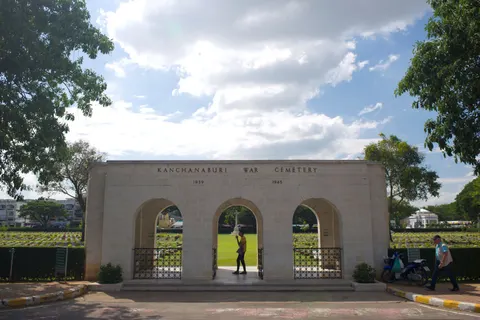
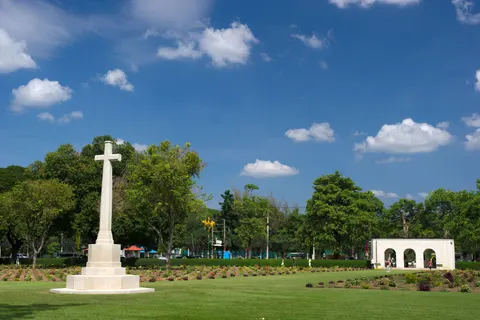
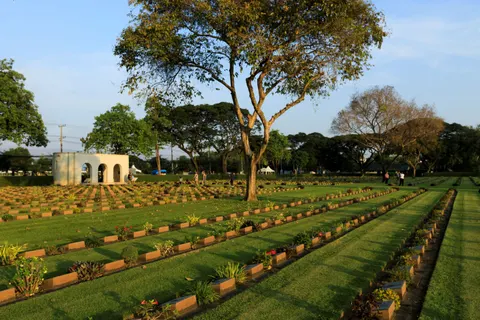
A stone triple-arched entrance building with bronze memorial panels and benches leads onto a large, flat, turfed rectangle. The Cross of Sacrifice stands at the far end, the Stone of Remembrance is on the far right and a memorial shelter with a seat is on the far left. Inside the entrance building the Kanchanaburi Memorial names 11 men of the undivided Indian army who are buried in Thai Muslim cemeteries. Graves are flat plaques set in the lawn and grouped in numbered plots. The ground is level, and there is a step-free service entrance beside the office.
Walk the central path to the Cross of Sacrifice first, then read a few rows on each side. Each plaque gives name, unit, age and date of death, and many carry a short line chosen by the family. Snakes can be present in the grass, so stay on the paths.
How to find a specific grave
- Open the CWGC Find War Dead search and enter the surname, and if you know them the first name, service number, unit or date of death. Narrow the results by choosing Kanchanaburi War Cemetery or Thailand.
- Open the record. It shows rank, unit, date of death, age and the grave reference.
- Read the grave reference as plot, row, grave. A typical reference looks like 2. J. 38, meaning plot 2, row J, grave 38. Collective graves appear as a range, for example 10. L. 6-12, and Dutch joint graves as, for example, III. D. Joint Grave 77-78.
- On site, ask at the office near the entrance for the cemetery plan, then walk to the plot and count along the row.
- If the search returns the Kanchanaburi Memorial instead of a grave, the man is commemorated on the panels in the entrance building. If the record shows Chungkai, the grave is at the other cemetery (see below).
Search the record before you travel and screenshot the grave reference, so you do not depend on a signal at the gate.
Chungkai War Cemetery and how to reach it
Chungkai lies on the site of the original burial ground started by prisoners at the Chungkai camp, which had a large hospital, so most of the men here died in that camp. The camp opened in October 1942, the hospital in November 1942, and both closed in June 1945. It was also designed by Colin St Clair Oakes. CWGC data lists 1,739 burials: about 1,371 British, 313 Dutch and 6 Indian, plus 49 unidentified Commonwealth graves. Totals can differ slightly, so use the number as a guide.
It is smaller and quieter than Don Rak, close to the river, and often has no other visitors. Grave references use the same plot, row, grave format, for example 4. C. 10. A ramped service entrance to the left of the main entrance gives wheelchair access.
How to get there
- By road: about 5 km west of town, over the narrow Sudjai Bridge. It is signposted from the Don Rak cemetery. By tuk-tuk or taxi, agree the return fare and the waiting time before you set off.
- By river: a ferry runs at the junction of the two rivers and river boats also serve it. Ask at your guesthouse for the current service before you rely on it.
- On a tour: most Bangkok day tours skip Chungkai, so ask your driver to add it or visit it separately.
JEATH War Museum or Thailand-Burma Railway Centre
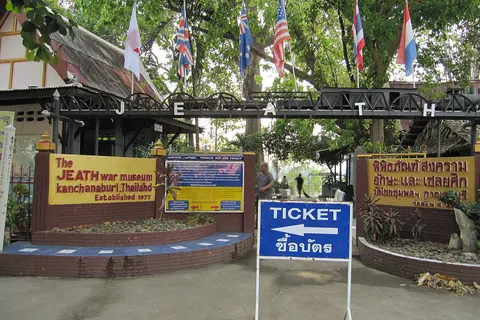
Both museums tell the story of the railway, but in very different ways. If you can only do one, choose the Railway Centre. If you have the time, do both, because they complement each other.
| Thailand-Burma Railway Centre | JEATH War Museum | |
|---|---|---|
| What it shows | A scale model of the full 415 km line, galleries on planning, forced labour, camp conditions, cholera and dysentery, Allied bombing and the end of the railway, personal items and first-hand accounts, and a research room for people tracing relatives | Reconstructed bamboo huts like those used by prisoners, with paintings, drawings, photographs, tools, weapons and maps, on the grounds of Wat Chaichumphon where the two rivers meet |
| Style | Modern, multimedia, English captions, air-conditioned | Simple, old-fashioned, not air-conditioned, run on a small budget |
| Time needed | 60 to 90 minutes; up to 2 hours if you read everything | 30 to 45 minutes |
| Price | About 150 baht; children cheaper | About 50 baht |
| Hours | About 09:00 to 17:00 daily; closes about 16:00 to 17:00, so do not arrive in the last hour | About 08:30 to 16:30 (check at the door) |
| Location | Opposite the Don Rak cemetery on Saeng Chuto Road | By the river, about 1 to 2 km away |
| Photos | Rules vary by gallery, look for signs | Not permitted in the first section; follow the signs |
| Best for | Anyone who wants the whole story, older children, hot days, people tracing a relative | A budget stop, people who like raw first-hand material, a short add-on on the way to the bridge |
The Railway Centre includes graphic images of starvation and disease, so think twice before bringing young children. JEATH was founded in 1977 by the abbot of Wat Chaichumphon. The name is usually explained as Japan, England, America/Australia, Thailand and Holland, the nationalities involved in the railway.
These are places of mourning for many families. Keep your voice low, do not pose on or lean against graves, and keep drones away from the cemeteries.
Anzac Day and the dawn service
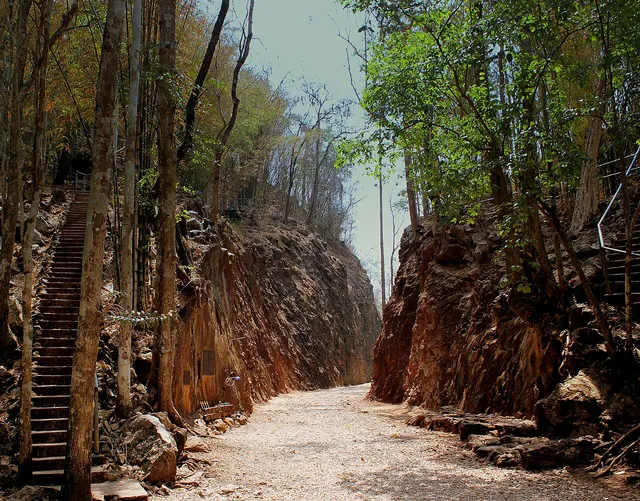
Anzac Day is 25 April. The only official Anzac Day service in Thailand is the dawn service at Hellfire Pass, about 80 km from Kanchanaburi, co-hosted by the Australian and New Zealand governments. It is not held at the Don Rak cemetery. In 2026 more than 1,000 people attended; wreaths were laid, the Last Post was played, a minute of silence was observed and a gunfire breakfast followed.
What to expect (based on the 2025 programme)
- 03:00: the Hellfire Pass Interpretive Centre and the adjoining Thai Army base open to the public.
- By 05:00: be in position at the memorial at Konyu Cutting. The ceremony starts at 05:30 and lasts about 40 minutes.
- The walk from the Centre to the cutting takes about 20 minutes over steps and an uneven, rocky railway bed. Free golf buggies are available for people with health or mobility needs; ask staff.
- Seating is first come, first served. Once seating is full people stand, and attendance is capped for safety. A live broadcast with sound is shown on a large screen in the car park, with undercover seating and toilets nearby.
- A gunfire breakfast is served afterwards at no charge.
- Wear clothing for very hot weather, sensible shoes, insect repellent and bring a small torch. No jacket or tie is required. Phones on silent, no smoking and no naked flames.
- You may bring flowers or a wreath. Wait for the announcement after the ceremony before laying them at the memorial obelisk.
The organisers do not run transfers. Hellfire Pass is about 80 km and about 1 hour from town on a winding, poorly lit road and about 3.5 hours (200 km) from Bangkok, so most visitors sleep in Kanchanaburi town or the Tha Sao area and arrange a taxi the night before. Book the room and the driver early. Registration was not required in 2025, but a registration page was used for 2026, so check hellfirepass.dva.gov.au or the Australian Embassy Bangkok page for the current year before you plan. If you cannot be at Hellfire Pass, you can pay a personal tribute at the Kanchanaburi War Cemetery at any time; check local Kanchanaburi social media for any smaller services held there.
Etiquette at the cemeteries and museums
- Dress modestly: shoulders and knees covered. A light scarf is enough.
- Speak quietly and keep children close. Running and loud calls do not suit the lawns.
- Do not step on, sit on or lean against the plaques.
- Photographs of the cemetery are fine. Do not pose in a joking way, and ask before photographing other visitors who are mourning.
- No drones at either cemetery.
- Phones on silent; take calls outside.
- Do not touch or remove anything left on graves by others, such as poppies, flags or notes.
- Take your litter with you and do not smoke in the grounds.
A half-day route and a full-day route
Half-day route on foot and by tuk-tuk
| Time | Stop | Notes |
|---|---|---|
| 08:00 | Don Rak cemetery | 30 to 45 minutes while it is cool. Walk to the Cross of Sacrifice and read a few rows. Pick up the plan at the office if you have a grave reference |
| 09:00 | Thailand-Burma Railway Centre | Cross the road. 60 to 90 minutes |
| 10:45 | JEATH War Museum | Tuk-tuk, about 1 to 2 km. 30 to 45 minutes |
| 11:45 | Lunch by the river | The bridge is a short ride away for the afternoon |
Full-day route by car, tuk-tuk or the Death Railway train
| Time | Stop | Notes |
|---|---|---|
| 07:30 | Chungkai War Cemetery | About 5 km west of town. 30 to 45 minutes. Quiet and cool. Have your driver wait |
| 08:45 | Don Rak cemetery | 30 to 45 minutes |
| 09:45 | Thailand-Burma Railway Centre | 60 to 90 minutes, air-conditioned |
| 11:30 | JEATH War Museum | 30 to 45 minutes, then lunch |
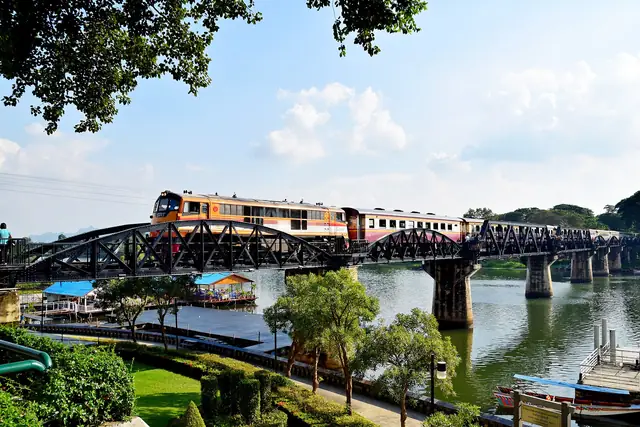
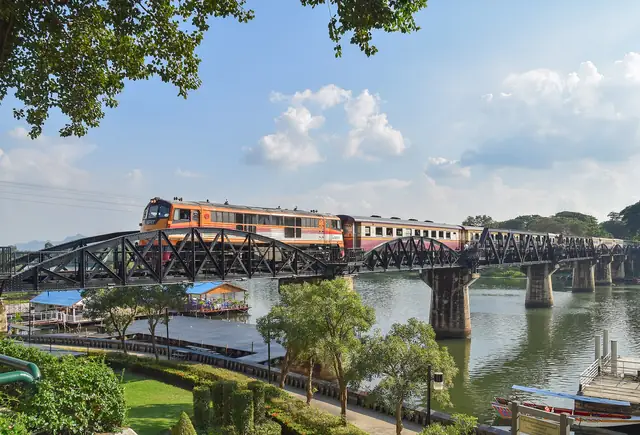
| 13:00 | River Kwai Bridge | Walk the bridge, which is a working railway bridge. Check train times first |
| 14:30 | Death Railway train | Board at Kanchanaburi station or the bridge for the ride toward Nam Tok. Check the current timetable and any flood closures with the State Railway of Thailand (hotline 1690) or at the station |
| Evening | Return by train or arranged taxi | Do not rely on a late return train unless you have checked the timetable |
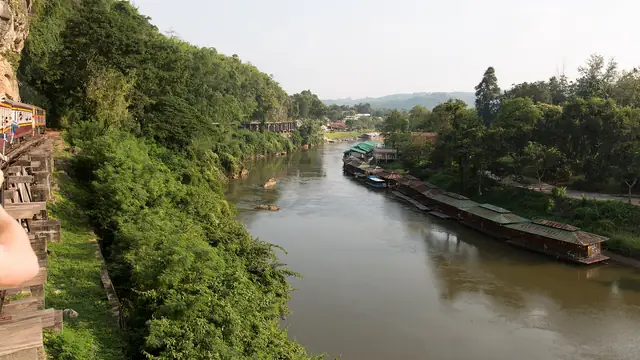
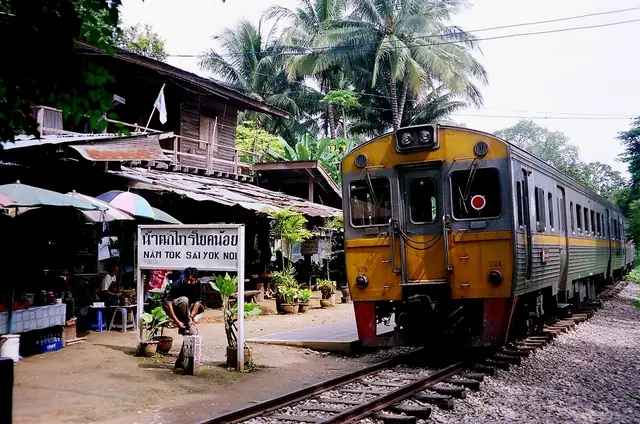
With a car or taxi hired for the day you can follow the same order without waiting for tuk-tuks. By tuk-tuk, agree a price per vehicle for the whole circuit and the waiting time before you start. By train, the Death Railway runs from Kanchanaburi toward Nam Tok, so you can end the day on the line. In late September 2026 flooding closed the line past Tha Kilen, but it reopened to Nam Tok on 3 October 2026 and no new closure had been announced as of 7 Nov 2026. Still confirm the current service before building your day around it.
River Kwai Bridge: how to walk and ride it
Best time to visit and accessibility
November to February is cooler and the most comfortable for walking the lawns, although it is also the busiest. March to May is very hot, so go at opening time and spend the middle of the day in the Railway Centre. May to October is the wet season: the cemeteries stay open, but plan for showers and slippery paths, and check river and rail conditions if you are heading further along the line. Early morning is the best time on any day, for quiet and for soft light.
Both cemeteries are on flat ground. Don Rak has a step-free service entrance beside the office, and Chungkai has a ramped service entrance to the left of the main one. The Railway Centre is air-conditioned and on two floors, so ask at the desk about lift access. JEATH is a series of simple huts on temple grounds, so expect steps and uneven floors.
A day tour that includes the Railway Centre and the cemetery
From Bangkok, this tour includes the Thailand-Burma Railway Centre, the war cemetery, the bridge, a ride on the Death Railway and lunch. It does not go to Erawan.
 KKday
Kanchanaburi River Kwai Bridge & Death Railway Day Tour
From US$69.04
Price as of 5 Nov 2026US$69.04 per person. About 10.5 hours with an English-speaking guide, lunch and the train ride. Free cancellation 1 day before (as of 5 Nov 2026).
Book on KKdayPhotos, prices and reviews from Klook
A 12-hour day tour from Bangkok with hotel pickup to the bridge over the River Kwai, a ride on the Death Railway, Hellfire Pass and the war cemetery, with lunch and an English-speaking guide, free cancellation. When Hellfire Pass is closed the tour visits Sai Yok Noi Waterfall instead, so check the closure dates on the booking page.
Railway, Hellfire PassFrequently asked questions
How much does the Kanchanaburi War Cemetery cost?
Nothing. Don Rak and Chungkai are both free to enter.
What time does the Don Rak war cemetery open?
It is open in the daytime and closes about 16:00 to 17:00, so check at the gate. Go in the morning, and if the gate looks shut ask at the office.
How do I find a particular grave?
Search the surname on the CWGC Find War Dead page, open the record and read the grave reference, which is plot, row, grave, for example 2. J. 38. At the cemetery, ask at the office for the plan, then walk to the plot and count along the row. If the record shows Chungkai, go to that cemetery instead.
How many people are buried at Kanchanaburi War Cemetery?
CWGC data gives 6,982 graves, including 3,569 identified British, 1,896 Dutch and 1,362 Australian casualties. Chungkai has about 1,739 burials.
Which is better, JEATH or the Railway Centre?
If you only have time for one, choose the Railway Centre for the full story, the research room and the air conditioning. JEATH is cheaper, simpler and more raw, and is a good short add-on.
How much are the JEATH War Museum and the Railway Centre?
JEATH is about 50 baht and the Railway Centre about 150 baht for adults, Prices change, so check at the desk.
How do I get to Chungkai cemetery?
It is about 5 km west of town over the narrow Sudjai Bridge, signposted from the Don Rak cemetery. Take a tuk-tuk or taxi and agree the return fare and waiting time before you leave.
Is there an Anzac Day service in Kanchanaburi?
Yes. The dawn service on 25 April is held at Hellfire Pass, not at Don Rak. In 2025 it started at 05:30, with guests in position by 05:00 and the site opening at 03:00. Stay in town the night before and arrange transport early.
Can I take photos at the cemetery?
Yes, respectfully. Do not step on or sit on plaques, do not pose jokingly and do not fly a drone.
Can I visit the war sites on a day tour from Bangkok?
Yes. One tour includes the Railway Centre, the war cemetery, the bridge and the train. Other tours visit only the bridge or JEATH, so read the itinerary before you book.
Where the facts come from
- Commonwealth War Graves Commission: Kanchanaburi War Cemetery
- Commonwealth War Graves Commission: Chungkai War Cemetery
- Commonwealth War Graves Commission: Find War Dead
- WW2 Cemeteries: Kanchanaburi War Cemetery (CWGC-derived data)
- WW2 Cemeteries: Chungkai War Cemetery (CWGC-derived data)
- Wikipedia: Kanchanaburi War Cemetery
- Wikipedia: Chungkai War Cemetery
- Wikipedia: JEATH War Museum
- Thailand-Burma Railway Centre
- Thai Holiday Guide: Thailand-Burma Railway Centre
- Australian Embassy Thailand: Anzac Day 2025 information
- Australian Embassy Thailand: Anzac Day 2026 dawn service
- Australian Department of Veterans' Affairs: Anzac Day at Hellfire Pass
- Tourism Authority of Thailand: The JEATH War Museum
Keep planning
 Plan your Kanchanaburi tripHow many days, what to see, fees and where to stay
 Kanchanaburi in one dayAn hour-by-hour plan from Bangkok
 Kanchanaburi in 2 days and 1 nightHistory, the train, a night by the river, then Erawan
 Kanchanaburi in 3 days and 2 nightsAdd Hellfire Pass and Sai Yok Noi
 Kanchanaburi tours and dealsDay tours and train options with prices
 Where to stay in KanchanaburiTown, riverside, raft houses and the Erawan side
 Bangkok to KanchanaburiBus, van, train and taxi compared
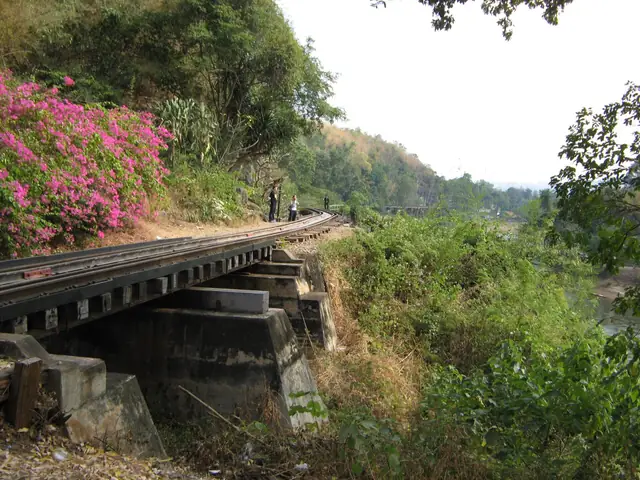 Getting around KanchanaburiScooter, taxi, songthaew and train
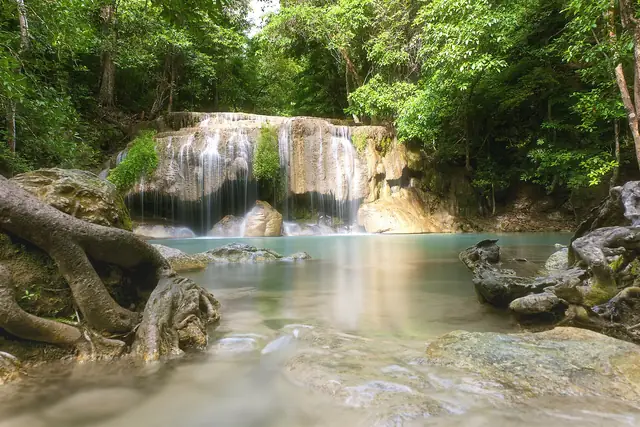 Erawan FallsFees, hours, the 7 tiers and how to go
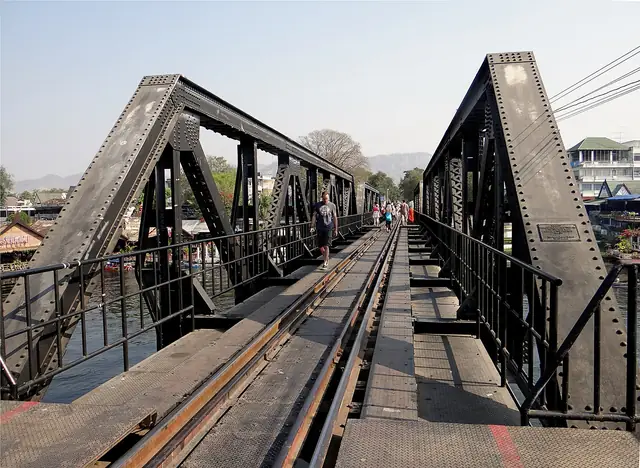 River Kwai BridgeHow to walk it, ride it and when to go
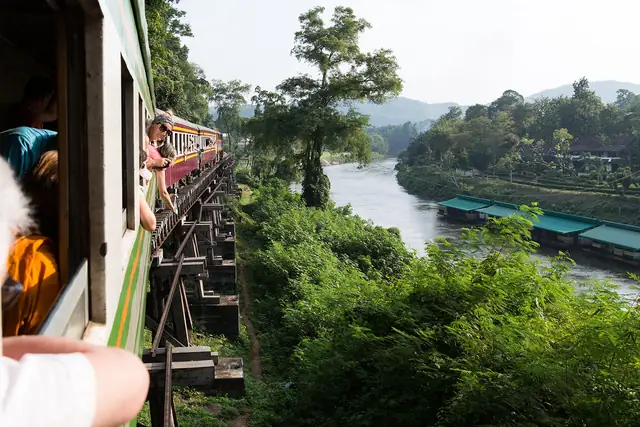 The Death RailwayTimetable, fares and Tham Krasae
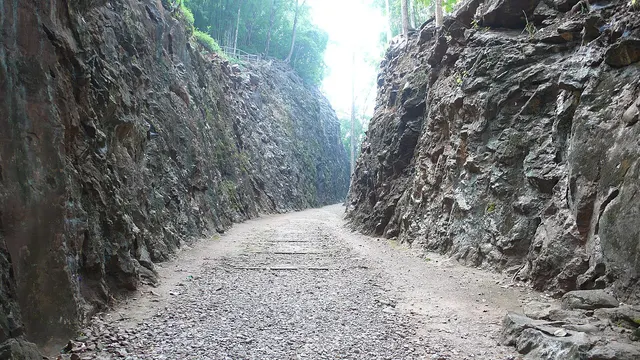 Hellfire PassFree museum, walking trails and current status
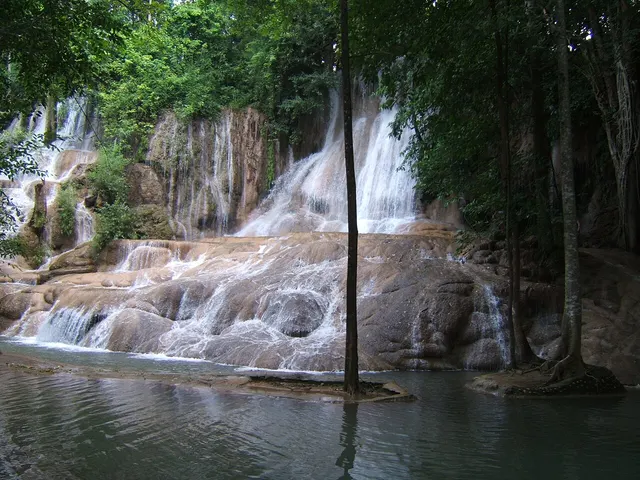 Sai Yok Noi waterfallBy Nam Tok station, not the same as Sai Yok Yai
 Elephant sanctuariesHow to choose one and what to ask